EV Battery Reuse: Saving CO₂ and Critical Raw Materials in Europe
The environmental potential of EV battery reuse is becoming increasingly tangible. Based on the batteries currently listed on REBATTEX, their potential reuse could already help Europe avoid more than 200 tonnes of CO₂ emissions and preserve more than 8,000 kg of critical raw materials compared with producing equivalent new batteries.
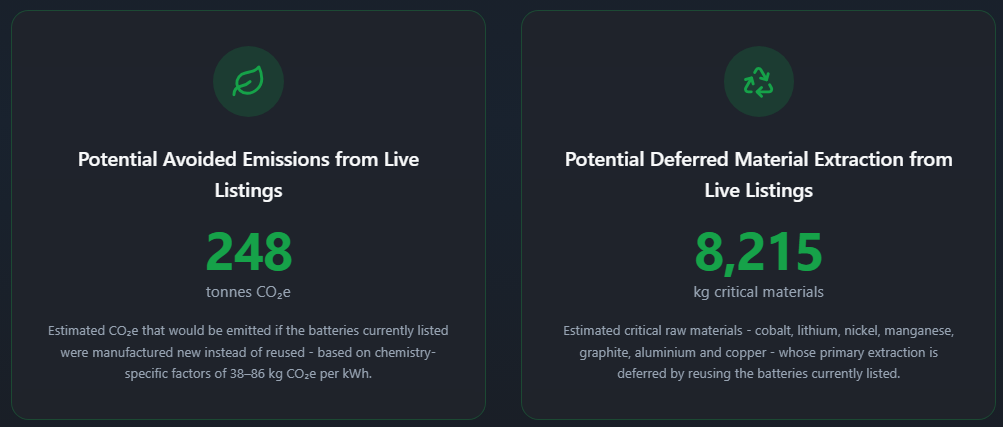
Before we build new batteries, let’s make better use of the ones we already have. The environmental potential of EV battery reuse is becoming increasingly tangible. Based on the batteries currently listed on REBATTEX , their potential reuse could already help Europe avoid more than 200 tonnes of CO₂ emissions and preserve more than 8,000 kg of critical raw materials compared with producing equivalent new batteries. That is something we are proud to see and it's only the beginning. Not because REBATTEX alone creates these savings, but because it demonstrates the potential value that already
exists in batteries currently in circulation. Reuse before replacement Europe will need many more batteries in the years ahead. Electric vehicles, energy storage and electrification will continue to drive demand for new battery production. But at the same time, thousands of EV batteries are leaving vehicles while still containing significant technical, economic and environmental value. An EV battery removed from a vehicle does not automatically mean that its useful life is over. Depending on its condition, it may still be suitable for: - vehicle repair and replacement - refurbishment -
second-life energy storage - other reuse applications Every battery that can safely remain in productive use allows us to extract more value from the energy and raw materials that went into manufacturing it in the first place. Battery reuse is difficult - but not impossible There is a reason why EV battery reuse has not yet reached its full potential. Batteries are complex assets. A buyer needs to know what the battery is, where it comes from, what condition it is in and whether it is suitable for the intended application. Reliable battery data, diagnostics, regulatory documentation and
traceability all matter. Without that information, uncertainty increases. And when uncertainty increases, perfectly usable batteries risk being recycled prematurely or simply becoming difficult to trade. This is one of the challenges REBATTEX wants to help solve. Data, compliance, traceability and trust REBATTEX does not solve every part of the battery reuse process. Our role is to help create the trusted infrastructure around the transaction. We work to ensure that four important elements are aligned when an EV battery changes hands: Battery data. Compliance. Traceability. Trust.
When buyers and sellers have access to better information and documentation, it becomes easier to identify suitable reuse opportunities and make informed decisions. That can help create a more transparent and efficient European market for second-life EV batteries . Making the environmental impact visible We also believe that the benefits of battery reuse should be visible. Circularity can otherwise easily become an abstract concept. But 200 tonnes of potential CO₂ savings and 8,000 kg of critical raw materials preserved are easier to understand. As more batteries enter the REBATTEX
ecosystem, we want to increasingly show both their economic value and their potential environmental value. Battery recycling will always be essential. Eventually, every battery reaches the end of its useful life and its materials need to be recovered. But when a battery can still be safely reused, reuse should come first. We will need new batteries. But first, let’s take care of the ones we have already created. Trace it. Trade it. Trust it.