REBATTEX joins Vinnova-funded REVIVE project to help scale EV battery reuse
REBATTEX, RISE, Chalmers University of Technology and SBR Sveriges Bilåtervinnares Riksförbund are launching REVIVE, a research and innovation project to explore how electric vehicle batteries can retain their economic and environmental value through reuse. Funded by Vinnova and coordinated by RISE, the project brings together research and industry to develop and validate circular business models for second-life batteries.
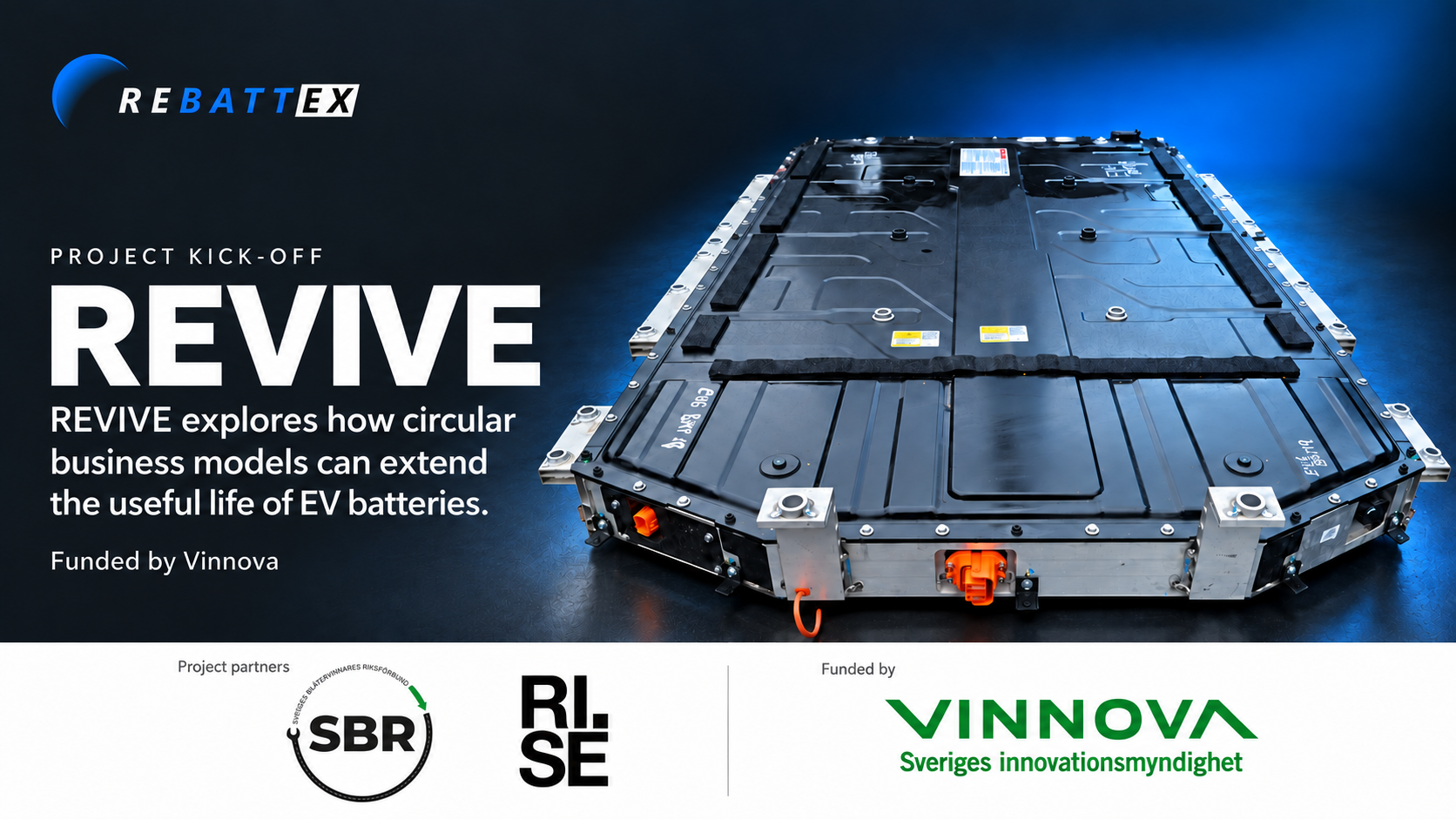
REBATTEX, RISE, Chalmers University of Technology and SBR Sveriges Bilåtervinnares Riksförbund are launching REVIVE, a research and innovation project to explore how electric vehicle batteries can retain their economic and environmental value through reuse. Funded by Vinnova and coordinated by RISE, the project brings together research and industry to develop and validate circular business models for second-life batteries. A battery reaching the end of its first use in a vehicle may still have value in another application. Realising that value requires reliable battery data, viable commercial
arrangements and clarity about ownership and responsibility. REVIVE - Reuse and Value Innovation for End-of-life batteries - will investigate how these conditions can come together to support battery reuse at scale. The project kicks off today and is scheduled to run until March 2028. “Battery reuse needs more than a buyer and a seller. It needs reliable battery data, traceability and clear responsibilities, supported by a business model that works for everyone involved,” says Andy Rietschel, CEO and Co-founder of REBATTEX . “Through REVIVE, we can bring practical experience from
our battery exchange into a joint research effort to understand how more batteries can stay in productive use, and under what conditions reuse makes both commercial and environmental sense.” Four business models, one practical question The project will examine four ways of organising the next stage of a battery’s life: Outright sale: ownership transfers to the next user. Fixed-term leasing: the owner retains the battery and leases it at an agreed price based on its condition. Performance-linked leasing: payments adjust according to measured battery performance. Reconditioning as a service: a
specialist assesses and reconditions the battery while the original owner retains ownership. Across these models, REVIVE will explore how ownership, revenue and risk are distributed, and which technical, regulatory, financial and organisational conditions enable adoption. It will also investigate how digital product passports and access to lifecycle data can support informed decisions and cooperation between actors. Connecting research with real transactions REBATTEX will contribute its battery exchange platform and industry experience to develop and validate practical approaches to battery
reuse. Its work will include business model testing, integration of technical and regulatory requirements, and validation through real-world use cases with partners across the battery value chain. RISE will coordinate the project and lead the work on circular business models. Chalmers will lead the development of a quantitative sustainability decision-support framework, combining lifecycle assessment with analysis of how different business models create value. SBR will contribute the vehicle dismantling sector’s experience, industry access and practical perspectives. The resulting framework is
intended to help companies assess when and on what terms to reuse, refurbish or move batteries into material recovery, considering both economic and environmental outcomes. About REBATTEX REBATTEX develops transaction infrastructure for second-life EV batteries, connecting sellers and buyers through a battery exchange that brings together battery data, compliance documentation and traceability. Its mission is to enable trusted transactions that support a circular battery economy. Trace it. Trade it. Trust it. Press contact Andy Rietschel, CEO, REBATTEX andy@rebattex.com rebattex.com